


Reverse Trade Up Strategy: Target Your Dream Skin
Master the reverse trade-up technique to target specific high-value skins. Learn how to work backwards from your desired outcome for maximum efficiency.
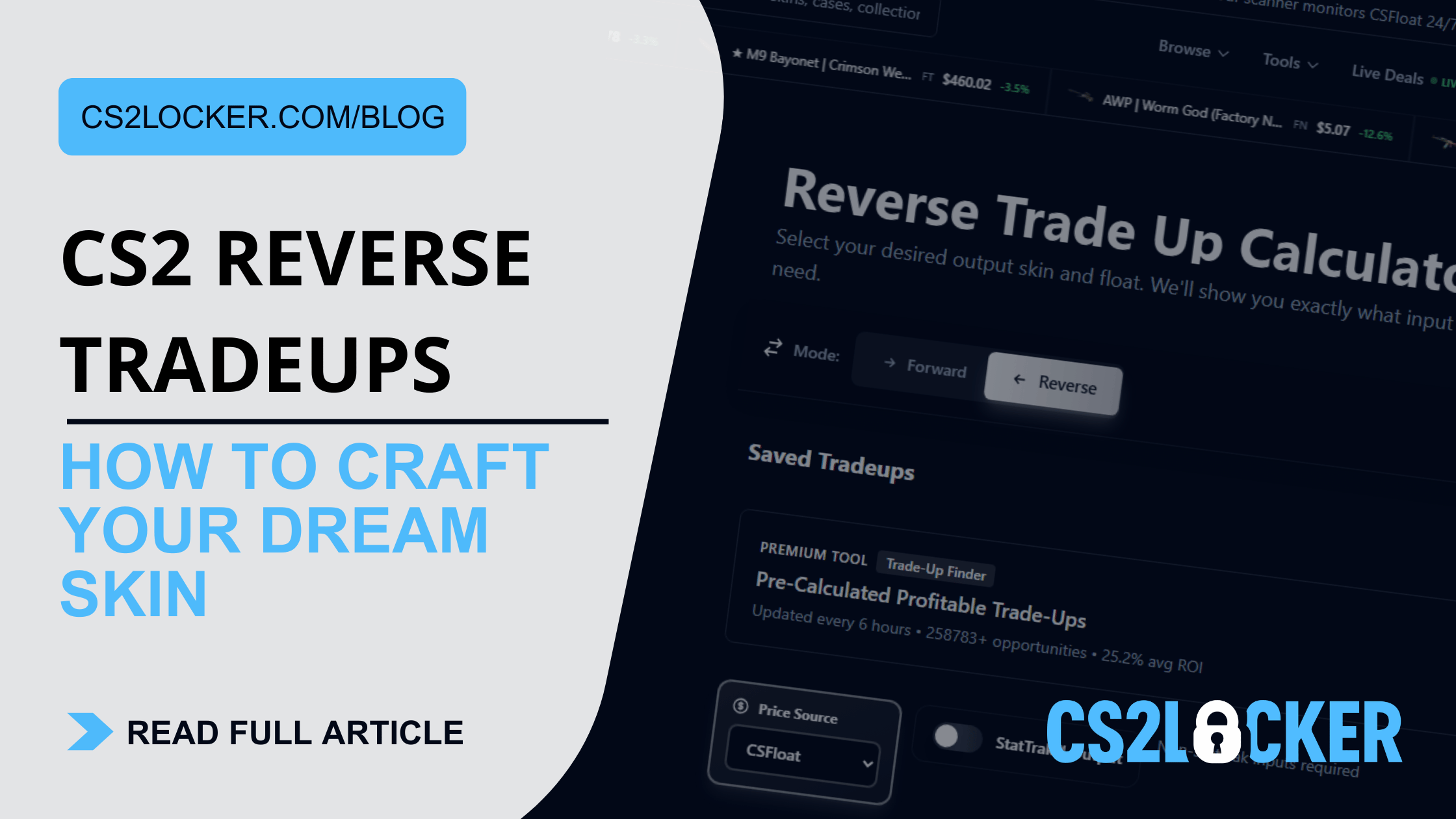
Most people approach trade-ups from the input side: they gather 10 skins, throw them in a contract, and see what comes out. I used to do this too. The shift in thinking that changed everything was simple - start from the skin you actually want and work backwards. Pick the output first. Then figure out the cheapest inputs that can produce it. That question reversal is what I call a reverse trade-up, and it's the philosophy behind how the reverse mode in CS2Locker's trade-up calculator was designed.
Written by Rick
Founder & developer of CS2Locker - CS2 player and skin collector since 2015.
What is a Reverse Trade Up?
In a standard trade-up, the question is "what can I get from these inputs?" In a reverse trade-up, you flip it: "what do I need to put in to get this specific skin?" It sounds like a small change but it completely reorients how you search for opportunities. Instead of browsing cheap skins hoping to find positive EV, you start with a target - a skin you actually want to own or sell - and work backwards to find the cheapest route to it.
The approach is particularly useful when the trade-up route to a skin is meaningfully cheaper than buying it outright. On high-value skins this happens more often than you'd expect, because input prices sometimes lag behind output prices when the market moves.
When to Use This Approach
Reverse trade-ups make the most sense when you're chasing an expensive skin - an AWP Dragon Lore, an AK-47 Fire Serpent, a specific knife - and the direct purchase price feels steep. If you need a specific float (a low float Factory New, for instance) and want to control the output condition precisely, the reverse approach with the float formula gives you that control. It also works well when you're completing a loadout and need one particular skin to finish the set, and when you're making an investment play on a skin you expect to appreciate.
On the other hand, reverse trade-ups are not the right tool when the inputs are illiquid and hard to find, when direct purchase is actually cheaper than the trade-up route, or when your target skin has no valid trade-up path - Contraband skins like the M4A4 Howl cannot be obtained through trade-ups at all.
How to Run a Reverse Trade Up
Step 1: Choose Your Target Precisely
Don't just pick a skin name - decide on the exact version you want. Factory New or Minimal Wear? StatTrak or non-StatTrak? What float range are you aiming for? These details determine your entire input strategy. A Factory New output at 0.01 float requires fundamentally different inputs than one at 0.06.
Step 2: Identify the Collection and Input Skins
Find which collection your target skin belongs to - this determines which input skins can produce it. Your inputs must be one rarity tier below the target and from the same collection (or collections, if you're willing to accept probability splits). Map out all available input options and what each currently costs across marketplaces.
Step 3: Calculate the Float You Need
The float formula runs in reverse too. If you know the output float you want, you can solve for the average input float required:
Required Avg Input = (Target Float - Min) ÷ (Max - Min)
From that number, you know exactly what average float your 10 inputs need to produce. You can then select specific skins with floats that hit that average - no guesswork, no surprises after the trade-up completes.
Step 4: Decide on Probability
Here is where you make the key strategic choice. If you want a guaranteed result, use all 10 inputs from the same collection - you will always get a skin from that collection's output pool. This costs more because you're locked into one collection's input skins. Alternatively, splitting inputs across two collections reduces cost but introduces variance: you might get your target skin, or you might get whatever the other collection offers. The question to ask with a split is whether the alternative outputs are acceptable - if the "bad" outcome is still worth reasonable money, a split can be smarter economics.
A Real Example: Targeting AWP Dragon Lore
The AWP Dragon Lore lives in the Cobblestone Collection, making it one of the more straightforward reverse trade-up targets - there is only one Classified skin in that collection, the M4A1-S Knight. That means every Knight you put in contributes a 10% chance at the Dragon Lore. Use 10 Knights, get a 100% guaranteed Dragon Lore. The catch is that Knight prices have risen substantially alongside Dragon Lore prices, so the input cost is high. But in periods where Knight is underpriced relative to Dragon Lore, the trade-up route genuinely saves money.
For the float: Dragon Lore ranges from 0.00 to 0.70. If you want a Factory New (under 0.07), you need very low float Knights as inputs. Run the formula before you buy - the math will tell you exactly how low your inputs need to average to land in the FN range.
Advanced Tips
When evaluating inputs, check whether different skins from the same collection are priced very differently - sometimes you can use a cheaper skin from the same collection and get nearly the same probability. Market timing matters more than people think: input prices for popular collections fluctuate with major CS2 news and player activity cycles. Waiting for input prices to dip before buying can meaningfully improve your margin. And if you're doing a split probability trade-up, always verify that the alternative outputs are worth something - a 50/50 split where one outcome is $200 and the other is $3 is not a $100 EV trade-up in practice.
Try the Reverse Mode Calculator
The reverse mode in CS2Locker's trade-up calculator automates all of this. You pick your target skin and specify the float you want, and it maps out every possible input combination with associated costs, probabilities, and expected values. It's the fastest way to find out whether a trade-up route is worth pursuing before you commit any money.
Попробуйте наш калькулятор контрактов
Применяйте эти знания с нашим бесплатным калькулятором контрактов
Открыть калькулятор контрактовПохожие статьи
How to Avoid CS2 Scams: Complete Prevention Guide 2026
Protect your CS2 inventory from common scams. Learn about API key scams, phishing, impersonation, and more with our comprehensive safety guide.
guidesBest AK-47 Skins in CS2 Ranked (2026)
The definitive ranking of the best AK-47 skins in CS2. From budget picks under $5 to legendary Covert skins, find your perfect AK with live prices.
guidesBest Budget CS2 Skins in 2026
Build a great-looking CS2 loadout without breaking the bank. The best affordable skins across all weapon categories with live prices.